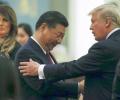
'While many Chinese policy makers dismiss the political, economic and technological component of US-India relations, they express caution on the defence-related ties which also happens to be a major driver in US-India relations,' explains China expert Srikanth Kondapalli.

Beijing now fears that the fallout of the NSG outcome could have an impact on a crucial verdict expected soon from the Permanent Court of Arbitration in The Hague in a case brought by the Philippines concerning China's territorial reclamation activities in the South China Sea.

In the opinion piece after the summit, the leaders said the cooperation, known as "the Quad," was born in crisis. It became a diplomatic dialogue in 2007 and was reborn in 2017.

'Little did those in India's strategic community realise that any wise adversary in China's place and circumstances would only take the land route to disturb and trouble India.' 'It is along the land border that all of India's post-Cold War allies would be of little or no political and diplomatic, and least of all, military help,' says N Sathiya Moorthy.

By changing the nation's name from India to Bharat, would this landmass overnight lose the emotional and cultural linkage that had been built over generations, centuries and millennia, asks N Sathiya Moorthy.

According to the Singapore Post, Kiribati a Micronesian country is discussing opening up its largest marine reserves to commercial fishing which may serve a dual purpose like a naval base for the Chinese as well.

The Indian Navy on Monday unveiled a 15-year plan to boost maritime infrastructure even as Chief of Naval Staff Admiral R Hari Kumar said the force is working with the Army and the IAF to ensure tri-services jointness and integration to meet future challenges.

'When Modi was having his maiden meeting with Donald Trump, China is up to its old tricks again, by causing a distraction on the Doklam plateau,' says B S Raghavan, the distinguished civil servant.

India's decision to skip the meeting came after a year of bilateral discord over China's stubborn opposition to India's entry into the Nuclear Suppliers' Group and a UN ban against Pakistan-based terrorist group Jaish-e-Mohammed leader Masood Azhar.
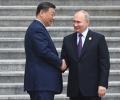
"The two sides note that the relationship between Russia and China has progressed to a more advanced interstate cooperation compared to the military-political unions of the Cold War era as it is not bloc or confrontational in nature, nor does it target any third countries," Russia's new agency Tass quoted the document as saying.

'Pakistan is a nuclear country.' 'With the kind of situation that is there in Pakistan today, America will help Pakistan stay afloat.'

The Indian Navy, which regards itself as the 'net security provider' in the Indian Ocean Region, has also stepped up to the plate, with a warship stationed at all times off the Gulf of Aden for counter-piracy tasks. 91 Indian warships have been deployed in the region since 2008, patrolling high risk areas where piracy was rampant.

'The fatal mistake for the USSR was the invasion of Afghanistan.' 'Quite possibly the fatal mistake for the Chinese empire is the assault on Ladakh,' observes Rajeev Srinivasan.
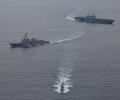
China said that military cooperation should be "conducive" to regional peace and stability.

President Biden underscored that the United States will 'continue to stand up for its interests and values and, together with our allies and partners, ensure the rules of the road for the 21st century advance an international system that is free, open, and fair', the White House said in a readout of the meeting.

With Fujian, China's third and most advanced aircraft carrier, having started sea trials last week, the PLA needed at least 200 qualified carrier-based fighter jet pilots to operate 130 ship-borne aircraft.

More than India's alignment with the Quad, India's defence cooperation and partnership with the USA is of critical importance, notes Rup Narayan Das.
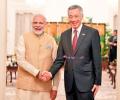
Modi hailed the close defence cooperation between the two countries and welcomed the completion of the logistics agreement between the two navies.

India as the G20 host has a 'unique role' to play in bringing about an end to the war in Ukraine due to its 'longstanding historical' ties to Russia, the United States has said, expressing hope to work closely with New Delhi to find a way to stop the conflict.

The National Security Strategy document should flag all major issues concerning security strategy and provide guidelines to concerned departments to work out suitable action plans. Since the global and regional geopolitical canvas is dynamic, the NSS document should be deliberated at length before formulation and should be reviewed periodically, recommends Commodore Venugopal Menon (retd).
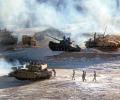
'India cannot allow Beijing's policy of stabilising and destabilising the border at will to perpetuate its own ends.' A riveting excerpt from Manish Tiwari's 10 Flashpoints; 20 Years National Security Situations That Impacted India.

As China tries to gain a foothold in the Indian Ocean region, Prime Minister Narendra Modi on Thursday said India recognised that there are other nations around the world, with strong interests and stakes in the region.
'We must be careful because China has not given its design in Eastern Ladakh.'
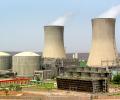
'Chinese are going bang, bang, bang building 30-35 reactors.' 'We should announce a programme of 50 new reactors and show that we mean business on the ground and not just announcements.'

Pakistan Prime Minister Shehbaz Sharif will take the USD 60 billion China-Pakistan Economic Corridor forward with new vigour, vitality and in a rejuvenated manner, ensuring the multifaceted development of the flagship project of China's ambitious Belt and Road Initiative, a top leader of the ruling PML-N has said.

The avalanche hit the arterial Jawaharlal Nehru Marg, which connects Gangtok to Nathu La at the China border, around 11.30 am, trapping five-six vehicles with around 30 people under the snow, the Army said in a statement.

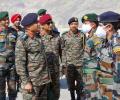
'China is playing the big global game.' 'Their ambitions lie far beyond the Line of Actual Control.'
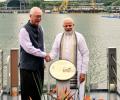
A beautiful rendition of 'Vaishnav Jan To Tene Kahiye', a favourite bhajan of Mahatma Gandhi, was sung on the occasion.

Chinese President Xi Jinping has underlined the need for building a combat-ready army and accelerate the building of the theatre joint combat command system, amidst the People's Liberation Army flexing its muscles in the disputed South China Sea.
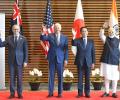
Biden welcomed Prime Minister Modi at the Summit and said "it is wonderful to see you again in person".
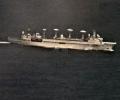
The permission to allow the Chinese ship comes amid strains in ties between India and Maldives after its new President Mohamed Muizzu came to power and made Beijing as his first port of call early this month after assuming office.
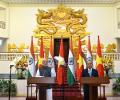
India on Saturday extended $500 million (Rs 3,328 crore) Line of Credit to Vietnam for facilitating deeper defence cooperation with the south east Asian nation, as the two countries elevated their ties to a Comprehensive Strategic Partnership to respond to emerging regional challenges.
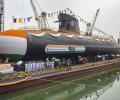
The status of the current submarine force level is alarming and we need to address the threat perceptions expeditiously. Critical decisions pertaining to national security cannot be delayed any further due to the rapidly changing maritime threat perceptions and growing strategic importance of the Indian Ocean region, asserts Commodore Venugopal Menon (retd).

He suggested evolving specific plans for cooperation with the 10-memeber grouping in key areas of maritime security, counter-piracy and humanitarian and disaster relief.
'China's opaque defence allocation processes are shrouded in mystery and have triggered security dilemmas among its neighbours and others,' notes China expert Srikanth Kondapalli.

Taiwan says it detected multiple Chinese aircraft and naval vessels taking part in military drills around the Taiwan Strait on Saturday, in what could be a possible simulated attack against the island.

From United States President Donald Trump and Russian President Vladimir Putin, Modi met them all.

Chinese military has identified a host of problems after conducting massive military exercises for the first time to sharpen the troops' fighting capability which if not rectified will hinder its ability to win wars.

'The Chinese are retaining geostrategic pressure on India by keeping troops there and building infrastructure continually.'
